
The Highest Virtue
Tao Te Ching: Chapter 38

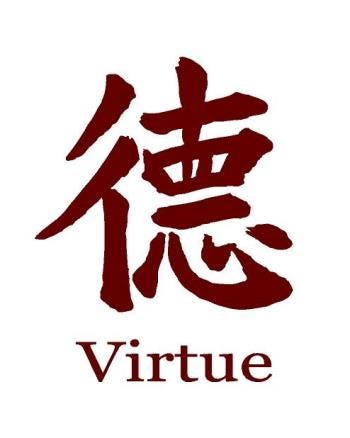
The word 德—transliterated as Dé or, more traditionally, Te—is obviously an important term for our understanding of the Tao Te Ching, insofar as it actually appears in the title of Laozi’s classic work. In the text itself, we have so far encountered 德 in Chapter 10 (where it was described as “Mystic”), Chapter 21 (where it was described as “Great”), Chapter 23 (where it was compared and contrasted with “Tao” and “Failure”), and Chapter 28 (where it was described as “Eternal”). Intrigued by Ursula K. Le Guin’s translation of 德 as “Power,” I recently considered revising my previous rendering into English of the word, but Dr. Hong took issue with Le Guin’s interpretation and advised against my making any changes to the chapters in which 德 has previously occurred. She assured me that 德 could only mean “Virtue”—which is how we have been translating it thus far—or possibly “Morality” or “Ethics.” I have therefore decided to continue translating 德 as “Virtue” for now, taking solace in the fact that no less an authority than Derek Lin does as well. I will also note that the English word “Virtue” is ultimately derived from the Latin word vir, meaning “man,” and hence means “Manliness.” Etymologically, at least, the translation of 德 as “Virtue” may thus retain a bit of Le Guin’s sense of “Power” after all.
Here in Chapter 38, Laozi further attempts to define the elusive term by distinguishing between “the Highest Virtue” (上德) and “the Lowest Virtue” (下德). Somewhat uncharacteristically, he then places Virtue within a universal hierarchy of values. At the top of that hierarchy, of course, is (1) Tao. Below Tao is (2) Virtue. Below Virtue is (3) Humanity. Below Humanity is (4) Justice. Below Justice is (5) Etiquette. It is significant that Laozi places Etiquette—an important Confucian value—at the bottom of his hierarchy. Chapter 38 may thus be considered one of the more explicitly anti-Confucian sections of the Tao Te Ching.
The Translation
The Highest Virtue is not virtuous:
Therefore, it has Virtue.
The Lowest Virtue does not lose Virtue:
Therefore, it has no Virtue.

The Highest Virtue does not act and has no intention.
The Lowest Virtue does not act but has intention.
The Highest Humanity acts but has no intention.
The Highest Justice acts and has intention.
The Highest Etiquette acts, and if nobody responds,
It raises its arm and compels.

Thus, when Tao is lost, Virtue appears.
When Virtue is lost, Humanity appears.
When Humanity is lost, Justice appears.
When Justice is lost, Etiquette appears.

As for Etiquette,
It is Loyalty's Frivolity
And the Chief of Chaos.
As for Prophecy,
It is Tao's Flashiness
And the Beginning of Stupidity.

Therefore, the Great Man dwells in profundity
And does not abide in frivolity.
He dwells in reality
And does not abide in flashiness.
So reject the latter and choose the former.
The Original
Wang Bi’s original prose:
上德不德,是以有德;下德不失德,是以無德。上德無為而無以為;下德無為之而有以為。上仁為之而無以為;上義為之而有以為。上禮為之而莫之應,則攘臂而扔之。故失道而後德,失德而後仁,失仁而後義,失義而後禮。夫禮者,忠信之薄,而亂之首。前識者,道之華,而愚之始。是以大丈夫處其厚,不居其薄;處其實,不居其華。故去彼取此。
Our poetic reformatting:
上德不德,
是以有德;
下德不失德,
是以無德。

上德無為而無以為;
下德無為之而有以為。
上仁為之而無以為;
上義為之而有以為。
上禮為之而莫之應,
則攘臂而扔之。

故失道而後德,
失德而後仁,
失仁而後義,
失義而後禮。

夫禮者,
忠信之薄,
而亂之首。
前識者,
道之華,
而愚之始。

是以大丈夫處其厚,
不居其薄;
處其實,
不居其華。
故去彼取此。
Terminology
仁 (rén) - “humanity,” “humaneness,” “benevolence”; the term previously appeared in Chapter 18, Chapter 19, and Chapter 33
義 (yì) - “justice,” “righteousness,” “impartiality”; the term previously appeared in Chapter 18 and Chapter 19
禮 (lǐ) - “etiquette,” “propriety,” “courtesy,” “tradition”; the term previously appeared in Chapter 31, where it was translated as “rites”
薄 (báo) - here translated as “frivolity,” the word more literally means “thinness”
華 (huá) - here translated as “flashiness,” the word can also mean “flower”
Notes
Some versions of Wang Bi’s text have 下德為之而有以為 in line 6, which would thus be translated: “The Lowest Virtue acts and has intention.” Both variants of line 6 are thought to be interpolations by some unknown editor(s).
Significant changes have been made to this translation since it was originally posted.