
The Highest Goodness is Like Water
Tao Te Ching: Chapter 8

“A clear stream of water runs through this book, from poem to poem, wearing down the indestructible, finding the way around everything that obstructs the way. Good drinking water.”
—Ursula K. Le Guin
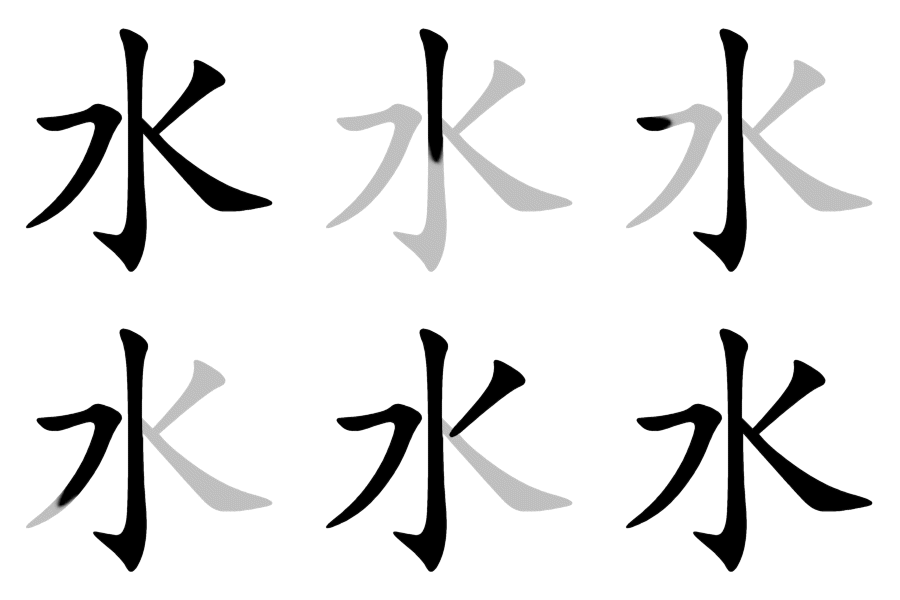
Thirsty for your weekly cup of Tao? I hope so, because the central image of Chapter 8 of the Tao Te Ching is water in all its “goodness.” In fact, the Chinese 水 (shuǐ) is here used by Laozi to exemplify the idiosyncratic characteristics of Tao itself. Bottoms up!
The Translation
The highest goodness is like water.
Water’s goodness benefits the Ten Thousand Things,
But it does not strive.
It dwells in the place that the multitudes hate,
So it is near to Tao.

A residence’s goodness is location,
The heart’s goodness is profundity,
Generosity’s goodness is being humane,
Speech’s goodness is confidence,
Government’s goodness is management,
Work’s goodness is ability,
Movement’s goodness is timing.

If a man does not strive,
Then there is no blame.
The first line of course reminds us of the first line of Pindar’s First Olympian Ode: ἄριστον . . . ὕδωρ (“Water is best”).
Dr. Hong is dissatisfied with my translation of the second stanza, because it does not make explicit the connections between all of these forms of “goodness” and water. Given her criticisms, I may need to reconsider some of the phrasing so that the second stanza is more obviously linked to the first. On the other hand, it’s possible that the connections are clear enough to the perceptive reader. What do you think, fellow traveler of the Way?
The Original
Wang Bi’s prose version:
上善若水。水善利萬物而不爭,處衆人之所惡,故幾於道。居善地,心善淵,與善仁,言善信,正善治,事善能,動善時。夫唯不爭,故無尤。
Our poetic reformatting:
上善若水。
水善利萬物
而不爭,
處衆人之所惡,
故幾於道。

居善地,
心善淵,
與善仁,
言善信,
正善治,
事善能,
動善時。

夫唯不爭,
故無尤。
Terminology
水 (shuǐ) or “water” is associated throughout with 善 (shàn), which is here translated with the noun “goodness.” In general, 善 is synonymous with 好 (hǎo), meaning “good.” It can also be translated with the adjectives “friendly,” “kind,” and “virtuous.” As a verb, 善 can mean “be adept in,” “be good at,” “be apt to,” and “make a success.”
An antonym of 善 is 惡 (è), meaning “bad.” As a noun, it means “badness,” “evil,” “ferocity,” and “vice.” Here it is translated with the verb “hate.” Other possibilities include “detest,” “despise,” “loathe.”
Another important concept in Chapter 8 is that of “striving”—or rather the lack thereof. The word 爭 (zhēng) can also mean “fight,” “contend,” “dispute,” “vie,” “struggle.”
The word 夫 (fū) appeared in Chapter 2 but was translated somewhat more freely than it is here in Chapter 8. It literally means “husband” or “man.”
The word 尤 (yóu), here translated “blame,” also means “outstanding,” “particularly,” and “especially,” as well as “fault” and “express discontentment against.”
Readers will already be familiar with the recurring 萬物 (“Ten Thousand Things”), 仁 (“humane”), 無 (“no”), and of course 道 (“Tao”).
Notes
Textually deviant reflections from three years ago:

Play this at 2x to avoid the awkward pauses:
Water is life!