Straw Dogs
Tao Te Ching: Chapter 5

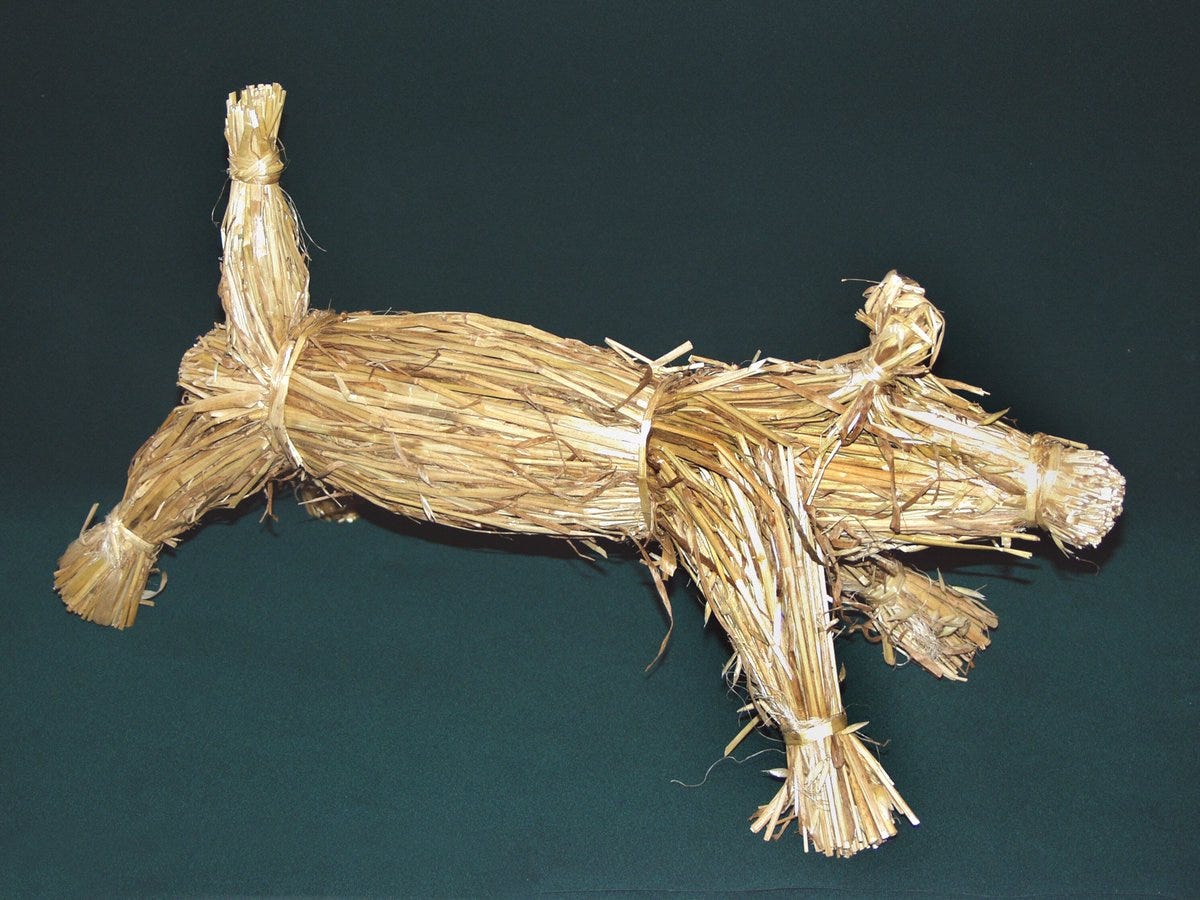
Yes, on the most literal level, we’re actually talking about canine-like dolls or figurines made out of straw. In ancient China, such objects served a ceremonial purpose as they were sacrificed to the gods in place of real, living dogs. (In the Orkney Islands, according to the link posted above, a “straw dog” was known as a bikko and was considered “an unwelcome gift, given to the farmer who had been last to finish his harvest and was traditionally made from the last of the straw to be cut.”) Mindful of the Chinese ritual context, the Taoist author and commentator Zhuangzi suggests that “straw dogs” (芻狗 or chú gǒu) represent things which are negligible, insignificant, easily ignored or discarded. However, according to Wang Bi, the editor of the Tao Te Ching whose text is the basis of our translation, the meaning of the phrase is more metaphorical: “straw” (芻 or chú) refers to all plants and “dog” (狗 or gǒu) refers to all animals. Thus, “straw dogs” would be all vegetable and animal—that is, non-human—life. Let us reflect on these various connotations as we consider the English rendering Dr. Hong and I eventually arrived at.
The Translation
Heaven and Earth are not humane:
They regard the Ten Thousand Things as straw dogs.
The Sage is not humane:
He regards the Hundred Families as straw dogs.

The gap between Heaven and Earth,
Is it not like a bellows?
It is void but inexhaustible.
The more it moves, the more it yields.

Too much talking causes many problems.
Better to remain in the middle.
The Original
Wang Bi’s prose version:
天地不仁,以萬物為芻狗;聖人不仁,以百姓為芻狗。天地之間,其猶橐籥乎?虛而不屈,動而愈出。多言數窮,不如守中。
Our poetic reformatting:
天地不仁,
以萬物為芻狗;
聖人不仁,
以百姓為芻狗。

天地之間,
其猶橐籥乎?
虛而不屈,
動而愈出。

多言數窮,
不如守中。
Terminology
The all-important concept of “straw dogs” (芻狗 or chú gǒu) was of course discussed above.
Appearing yet again in the text of the Tao Te Ching are the ubiquitous “Heaven and Earth” (天地 or tiāndì), “Ten Thousand Things” (萬物 or wànwù), and “Sage” (聖人 or shèngrén). See Chapter 1, Chapter 2, etc.
Instead of “the People” (民 or mín) mentioned in Chapter 3, here in Chapter 5 we have “the Hundred Families” (百姓 or bǎixìng) or, more literally, “the Hundred Surnames.”
The phrase 不仁 (bùrén) has been translated “inhumane.” As suggested above, it may refer to non-human life, with a focus on the plant and animal kingdoms. The word 仁 (rén) is clearly related to 人 (rén) or “human being.” 不仁 may also be translated “heartless” or “numb.”
The phrase translated as “bellows” is 橐籥 (tuó yuè). In modern Chinese, it refers to “bellows for blowing up the fire in a furnace.” Dr. Hong, influenced by Wang Bi’s commentary on the text, thinks this may indicate the potentially destructive aspects of “too much talking” (see the penultimate line of our translation above).
We translate 虛 (xū) as “void,” which may remind one of “empty” (沖 or chōng) in Chapter 4.
The evocation of “the middle” (中 or zhōng) is perhaps analogous to the Buddha’s “Middle Way” and Horace’s aurea mediocritas or “golden mean.” The idea here is to embrace moderation and not run to extremes—a sentiment reflected in the Greek axiom inscribed on Apollo’s temple at Delphi: μηδὲν άγαν (“nothing in excess”). Derek Lin disagrees with this interpretation, however, and translates 中 (zhōng) as “quiet.”
Notes
Sam Peckinpah was famously inspired by Chapter 5 of the Tao Te Ching:
There was a recent remake of Peckinpah’s film:
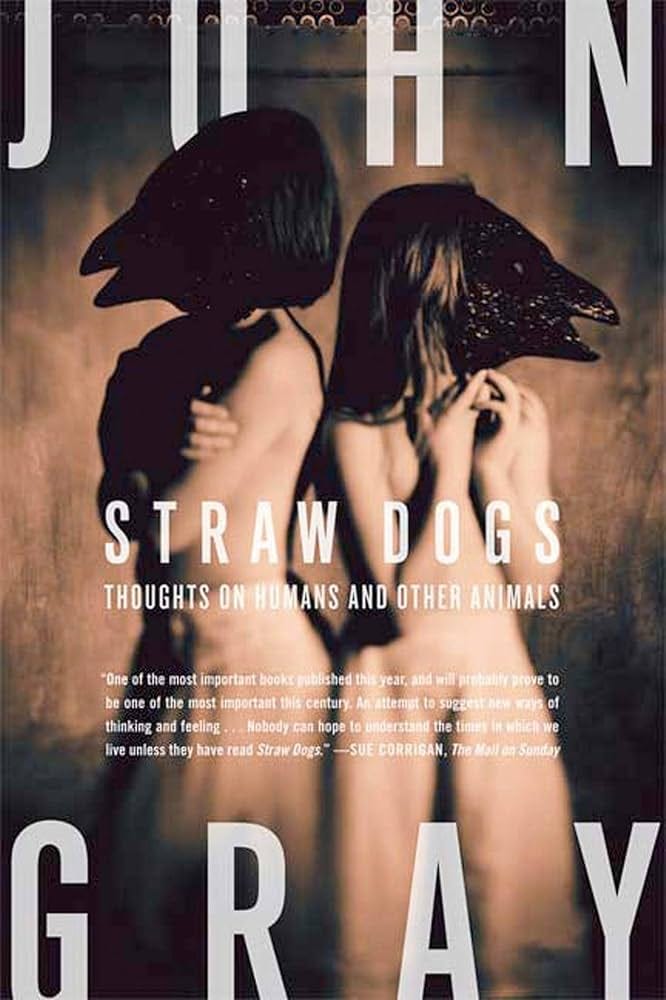
This book looks like a must-read:
3 Body Problem has another way of putting it: