
Istanbul [Part 1]
Rondo à la Turka: Chapter 1 [Part 1]

Below is the next installment of my forthcoming travelogue, Rondo à la Turka, which I am serializing here on Substack. For more information on this project, see my post “Invitation to a Fantastic Voyage.”
AND THE WRONG WORDS MAKE YOU LISTEN IN THIS CRIMINAL WORLD
I do not understand how anyone could see the humiliation rituals we undergo at airports as anything other than a reminder to the peasantry that the elites can do whatever they want with us. It is as though the bureaucratic agents of the organized crime syndicates known as governments are openly mocking their hapless subjects: “Attention, cattle! Prepare to be herded into pens!… Before entering this legally nebulous space, please remember to toss your bottled water in the recycling bin. We can’t have you hijacking the plane with an illicit beverage, can we?… Well done, worker bees! Now take off your shoes, your belts, and your hats. No, you can keep your socks on. Excellent! Your compliance is greatly appreciated!… Are you ready for the next round of inspections? It’s time for us to install spyware on your phone and laptop! Please put these items in the tray we have provided for your convenience. Thanks in advance for your cooperation!… By the way, do you really need all those electronics, you silly little children? Reconsider your carbon footprint and help us save the environment. We all have to do our part to fight climate change, eh?… Now please step inside the orgone accumulator for a complete body scan. Trust us, we’re professionals. We need to see what’s going on underneath all that clothing. It’s interesting for us to observe so many different body shapes and sizes. And don’t worry, everything is being saved to our hard drive and then uploaded to the cloud for eternity…. Congratulations, sir or madam, you have been selected for a physical pat-down in the extra-constitutional zone! Right this way please! Stay silent as we arbitrarily fondle your private parts behind this flimsy screen. Such is the price of freedom and security if you want to travel in the Age of Terror…. We’re almost finished, serfs! Please proceed in an orderly fashion to customs. Since checking your passport with the naked all-too-human eye is insufficient for the safety of all passengers, we kindly ask you to provide your biometrics without protest or murmur…. What’s that? Oh, no, dear sheeple, DNA samples are not currently required. We simply need to scan your fingerprints and eyeballs for our database. Thanks for helping us build the digital concentration camp in which we intend to imprison you! Have a pleasant trip!”
BORDER SECURITY MANAGEMENT
Outraged and disgusted by this state of affairs, I am determined to test the limits of what’s possible at Taiwan Taoyuan International Airport. Seeing no way around the basic security checks, I submit like a bitch to having my bags and electronics scanned. When asked to remove my belt and shoes, I meekly comply, but when the lackey motions for me to remove my cap as well, I say: “You just want to see the foreigner’s bald head, don’t you?” He is not amused. After undressing for the scanners and then dressing again at the ramshackle table behind the conveyor belt, I am fuming. By the time I get to passport control, I have had enough of this nonsense. A young lady directs me to one of the automated border control gates in the middle of the hall, where I am told I can simply scan my passport and be cleared. I try this but the e-gate does not recognize my passport. The young lady then directs me to a booth on the far right of the hall where another young lady is seated. This other young lady inspects my passport and alien permanent resident card and then asks me to look into her little camera and place my index fingers on her little scanner. I ask her if there is a problem with my passport or my alien permanent resident card and she says no. I inform her that I therefore wish to opt out of the biometric part of the procedure. She does not understand the English phrase “opt out” and I don’t know the Chinese. “Is it required?” I ask her. She looks at me blankly. “Do I have to do it?” I ask. She says yes. Like Bartleby the Scrivener, I say: “I would prefer not to.” “What?” she asks. “I don’t want to do it,” I reply. Grimly, she summons a tall, muscular gentleman to her station. He grabs my passport, alien permanent resident card, and boarding pass without so much as a word or a look in my direction. I chase after him, demanding answers. He walks briskly to the opposite end of the hall and halts at another, more isolated booth, which is otherwise the same as the booth I have just left. He turns and berates me in Chinese. “Ting bu dong,” I say. “You don’t understand Chinese?” “No,” I say. He is clearly infuriated. “Are you upset?” I ask with feigned concern. To admit that he is would entail loss of face, so he says no, but his tone and mien indicate the contrary. “You must scan your face and fingerprints! It’s the law!” He is almost shouting. “You told her you didn’t want to!” he adds. “That’s true,” I explain, “but there’s more to it than that. I asked her if it was possible to opt out. Am I not allowed to ask about my options?” He does not know how to answer this, so he repeats: “It’s the law! You must scan your face and fingerprints!” I say: “I don’t know the law. That’s why I was asking.” “It’s the law! You can Google it!” Now he actually is shouting. “Well, I can’t Google it right now, can I?” I ask sarcastically, also raising my voice. Again, he doesn’t know what to say. To end the standoff, I say: “Are you telling me I have no choice in this matter but to allow you to scan my face and fingerprints?” “Yes!” he declares definitively. Since I’ve already had this done multiple times over the course of my sixteen years in Taiwan, I reason that I won’t be giving the powers that shouldn’t be anything they don’t already have on me. Cursing under my breath, I grab my passport and alien permanent resident card from the tall, muscular gentleman and hand them to the young lady (yet another one) at the more isolated booth. I look into her little camera while placing my index fingers on her little scanner and the glass partition magically opens for me.
FORMOSA, MON AMOUR
“What did you say to that guy?” asks Mrs. Will, who is waiting for me so we can walk together to the departure gate. “Long story,” I tell her. “Say, am I legally required to let them scan my face and fingerprints?” “Don’t ask me,” says the wife. “Check online.” I do just that when we get to Gate D8 (although I ask DuckDuckGo rather than Google to conduct the search). I find an English version of the immigration law on a page labeled “Border Security Management.” It turns out that the scanning of eyes and fingerprints at passport control is in fact a legal requirement. But the website also says that once this has been done, even non-Taiwanese legal residents should be able to use the e-passport gates. Why then did it not work for me? They have all of my data, but it seems that they are unable to correlate it with my passport and alien permanent resident card. In the end, I decide this lack of correlation may actually work to my advantage. I suddenly realize that there will be certain benefits to living on Ilha Formosa when the Worldwide Clampdown finally comes. Because the Taiwanese are utterly inconsistent and incompetent in their implementation of official policies—as was clearly demonstrated during the Covid Era, as well as before and after—they tend not to make very good authoritarians. With a little cunning and ingenuity, I should be able to dodge at least some of the bureaucratic darts they will inevitably continue throwing in my direction.

FLYING TO BYZANTIUM
There has been a two-hour flight delay, so by the time we board for this thirteen-hour flight on Turkish Airlines I am ready to strap in and go to sleep as soon as possible. Before takeoff, however, I am struck by the singular beauty of a redheaded stewardess. For some stupid reason, it had not previously occurred to me that there might be Turkish redheads. I tell Mrs. Will I will give her 100 New Taiwan Dollars if she will call the stewardess over and say: “Hey, Big Red, are you red everywhere?” Mrs. Will does not find this obscene attempt at jest humorous in the least. Well, who could blame her? My jokes are not landing today, so I begin singing Bowie’s “Fantastic Voyage” into my wife’s ear. This makes her smile, so I know that all is well. After takeoff, a light meal is served: beetroot salad with balsamic sauce, chicken breast and cabbage salad, beef with soy sauce, sauteed spinach, carrots, and rice, with cheesecake for dessert. Mrs. Will has the penne with mushrooms instead of the beef and then informs me that it is the worst in-flight meal she has ever had in her life. She orders a glass of red wine while her husband has a cup of hot green tea. I pass out after the sumptuous repast and sleep eight or nine hours, waking up intermittently to stretch my neck and change my position. Somewhere over the Caspian Sea we experience turbulence. As others watch movies, listen to music, or play games on the in-flight entertainment system, I study the flight maps. We fly past Lake Balkhash between Astana and Tashkent, and I suddenly have the urge to visit Kazakhstan and Uzbekistan. Every half hour or so, I check the direction of the quibla, which changes in relation to our flight pattern of course, and I make note of the five prayer times. From the time we reach Trabzon, near the easternmost edge of the Black Sea, to the time we begin our approach to Istanbul, near the westernmost edge of the Black Sea, it is at least two hours. Before landing, we are served another light meal of seasonal fresh fruit, muesli, scrambled eggs with sauteed potatoes and zucchini, cherry tomatoes, and oven fresh bread with jam and butter. Mrs. Will has the shrimp congee—the so-called local option—instead of the scrambled eggs and reports that it is acceptable but not what she would call good. I learn too late that throughout the flight cheddar cheese sandwiches and chocolate muffins as well as roasted salted peanuts and sea salt crackers have been available for passengers upon request. As we make our descent to Istanbul, I scroll through images of Turkish tourist sites on the screen of the in-flight entertainment system: Göcek, Midyat, Mount Nemrut, Rize, Rumkale, Sümela Monastery, Harput Castle, Günpınar Waterfall, Maiden’s Tower, Hagia Sophia, Aphrodisias, the Trojan Horse at Çanakkale, Selimiye Mosque, Galata Tower, Safranbolu, and Kars. Maybe Türkiye really is “the World’s Largest Museum.”
TO THE CITY
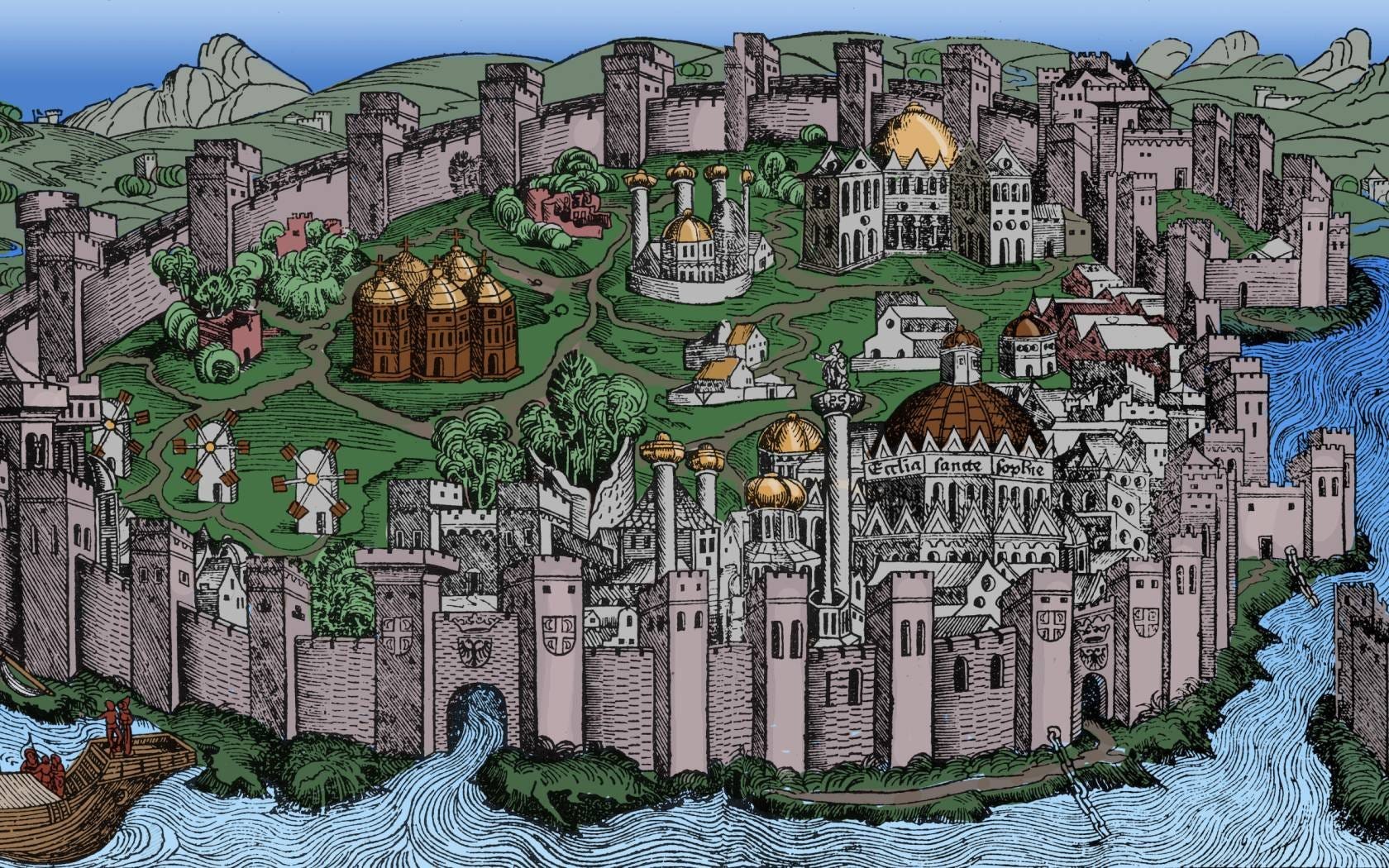
It is about 8 PM local time when we touch down at Istanbul Airport. After exiting the plane we follow our Taiwanese guide Mr. Huang, English name Andy, who is holding aloft the red flag of Dragon Travel. Customs is much easier here at our destination. There is safety in numbers, it seems. Andy takes the passports of all members of our tour group and is able to rush us through the process without any major hassles. As we walk en masse from baggage claim to the welcome area, I notice a sign advertising a shuttle bus from the airport to the city center and am reminded of the etymology of this great cosmopolis in which we have just landed. The Turkish name Istanbul is derived from the Greek phrase εἰς τὴν πόλιν, which means “to the City.” The City in question is of course Constantinople or the “City of Constantine.” But the emperor was renaming after himself the Thracian town known in Greek as Βυζάντιον (Byzantium in Latin). At this point, however, that’s nobody’s business but the Turks’.
ENTER THE SKY-KING
At the welcome area, where we see a Popeye’s Chicken and a Starbucks, Andy introduces our tour group to the local guide, who looks like a Turkish Louis CK. After saying da jia hao, he speaks entirely in English (which suits me just fine) and Andy translates into Chinese. His name is Gökhan, which he says means Sky-King. This, he explains, was also the name of one of the six sons of Oghuz Khan, eponymous ancestor of the Oghuz Turks. Andy tells the Taiwanese members of our group—i.e., everybody but me—that the name Gökhan is the equivalent of the Chinese phrase Tianwang, but he suggests that everyone simply call Gökhan “John.” In my mind, however, Gökhan will always be Gökhan and I refuse to call him John. Gökhan leads us to the tour bus, where we meet our driver, Mehmet, who knows very little English but is very friendly. The wife and I board the bus and sit in the second row, just behind Andy. Gökhan points to the large framed map of his native land which is mounted at the front of the bus. Standing up and facing us as Mehmet drives to our hotel, he speaks into a microphone connected to the bus’ PA system. When necessary, Gökhan hands the microphone to Andy, who translates into Chinese. Gökhan explains that Türkiye is a country, not a bird, and should therefore never be called Turkey. When I hear him say this, I decide that I like our local guide already. He knows we are tired and will not overburden us with information, but he tells us the airport we have just left is on the European (that is, western) side of Istanbul and was built six years ago. Our hotel, the Ramada Inn, is also on the European side of the City, but it will take about half an hour for us to arrive there. Gökhan further explains that the European and Asian sides of Istanbul are divided by the Bosphorus, which literally means “Ox-ford.” According to legend, a Greek girl named Io was transformed into a cow—either by her lover Zeus or by Zeus’ jealous consort Hera—and was continuously stung by a gadfly while being forced to wander the earth. She eventually collapsed in the strait between the Black Sea and the Sea of Marmara, which came to be named in commemoration of her mythological misadventure. There she met Prometheus, who somehow made his way to this region after having been chained on Mount Caucasus by Zeus. The fire-thief informed the cow-girl that she would become the great-great-great-great-grandmother (give or take a great or two) of Heracles, the most heroic of all heroes. She allegedly accepted this as consolation for her many sufferings.
SOS!
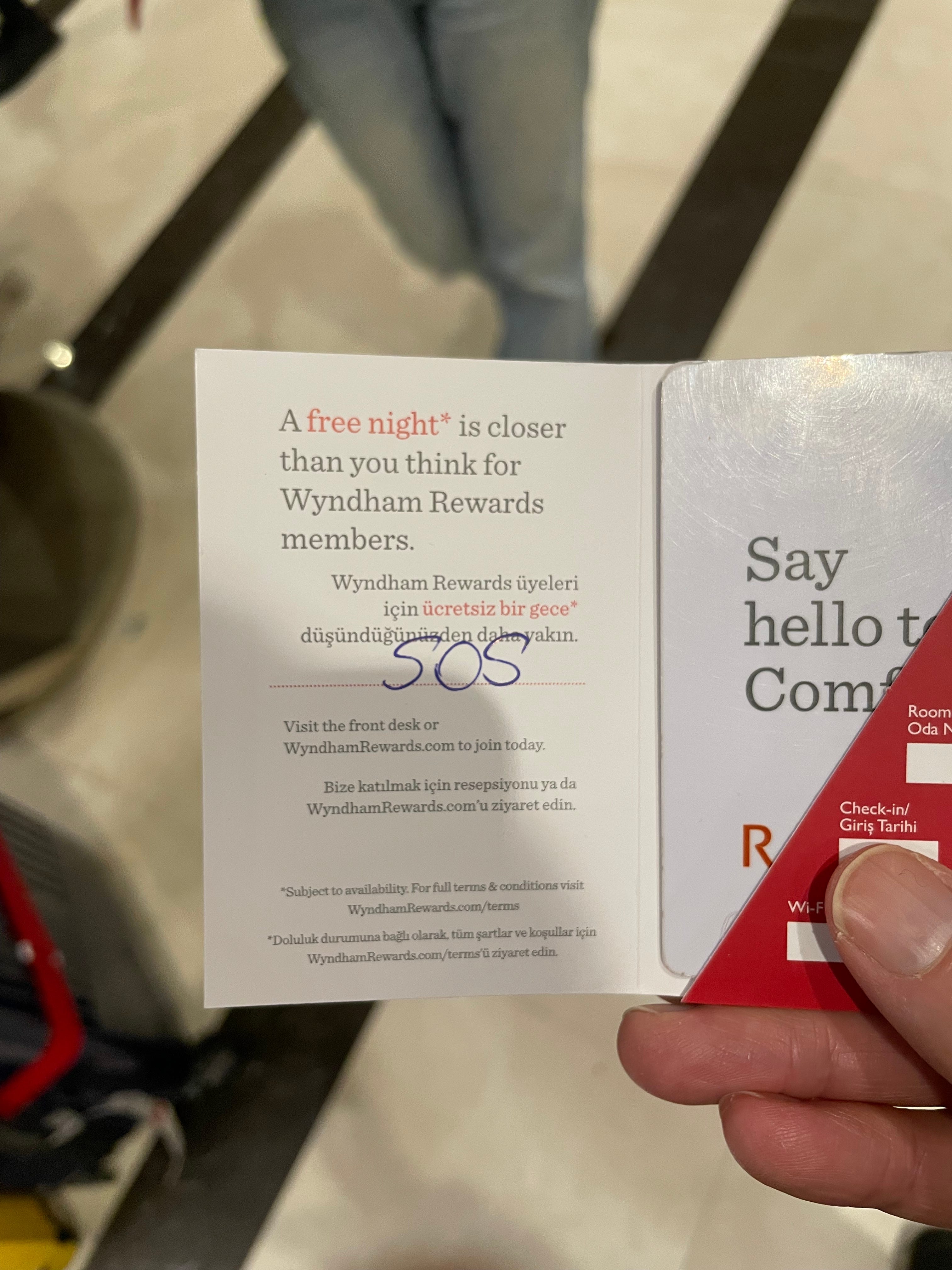
We arrive on the bus at the Ramada Inn, which the itinerary has assured us is a five-star hotel. Outside, it is snowing lightly, which reminds me of Orhan Pamuk’s most famous novel. It is much colder here than it was in Taipei. We wait in the lobby as Gökhan and Andy collect all the passports to facilitate group check-in. Soon Gökhan gives us the key to our room. The plastic doorkey is in a cardboard sleeve on which is written the room number 505—but the fives look less like numbers and more like letter esses. This would seem to be a bad omen and it proves to be so when we enter the room thus designated “SOS.” There is a burned-out light in the bedroom. The vent is moldy and a screw is missing from its screen, which looks as though it might fall off the wall at any moment. The shower is scalding hot and we cannot figure out how to adjust the temperature. The icing on the cake, as it were, is what appears to be a clump of nosehairs encrusted with dried snot, which has been left for our edification on the writing desk next to the TV. Is this what qualifies as a five-star lodging experience in Türkiye?
JEFFREY, WE HARDLY KNEW YE
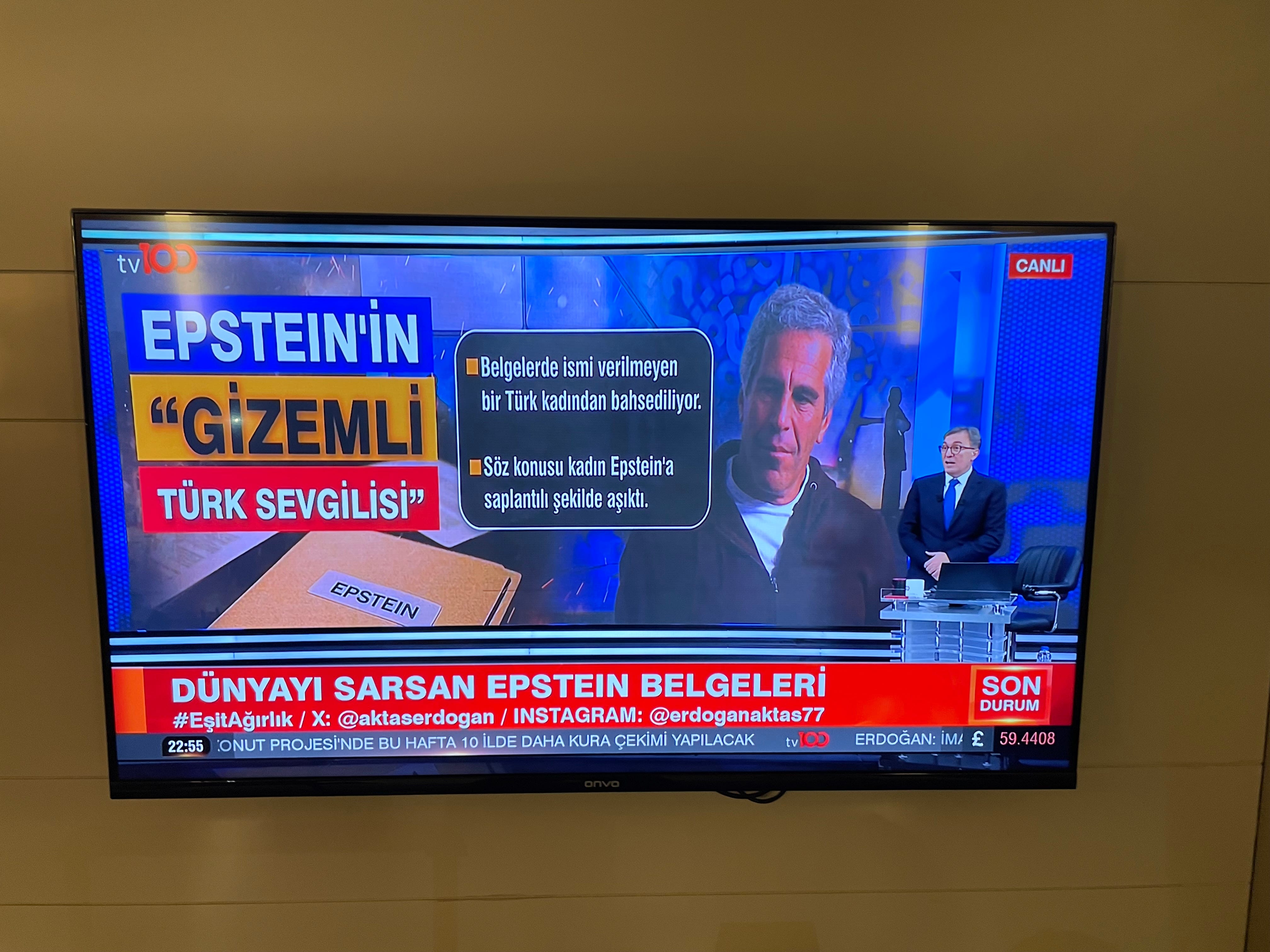
I turn on the TV and hear nothing but Turkish. Even Western channels like TLC and Animal Planet are dubbed into the vernacular. I flip to a Turkish news channel and see pictures of Jeffrey Epstein. Turkish commentators are speaking gravely in Turkish about what appears to be a matter of Turkish national interest. There seems to have been yet another scandal involving Israeli intelligence’s favorite blackmailer. But what is Türkiye to Jeffrey or Jeffrey to Türkiye? I use the Google Translate app on my phone to read what’s on the screen. At the top it says “Epstein’s Mysterious Turkish Lover.” Beneath this heading are two bullet points: (1) the Epstein Files mention an unnamed Turkish woman and (2) the woman in question was obsessively in love with Epstein. Well, this is news to me! Enquiring minds want to know more!
IT’S A DOG’S TOMORROW
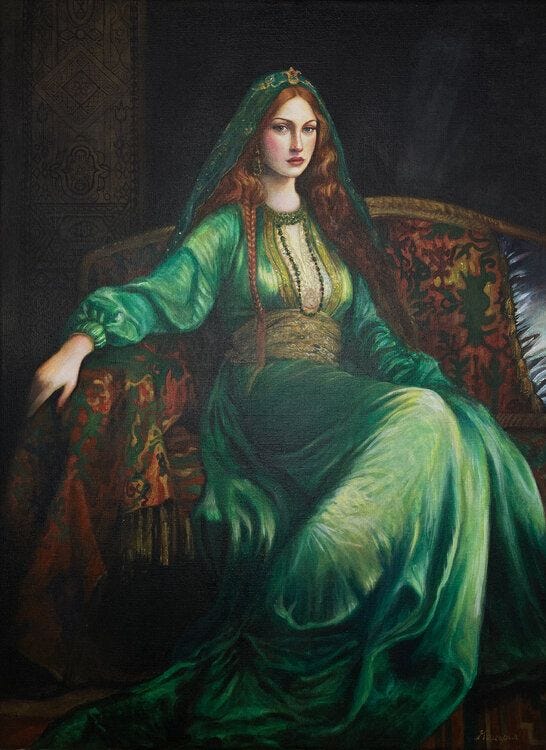
Sometime after midnight, the Lodgers have showered and are ready for bed. We must sleep soon as we will have an early wakeup call. The itinerary says that in the morning we will be visiting Sultan Ahmet Square, which according to Google Maps is 23 minutes by car from our current location. I skim the travel book I purchased at a second-hand Taipei bookstore before we left on this fantastic voyage and see that the Sultan Ahmet complex includes the Blue Mosque, the Hippodrome, Hagia Sophia, and the Baths of Roxelana. My attention is drawn to one of those inserts often found in travel books. It features a picture of Roxelana, the “power-hungry wife” of Suleiman the Magnificent. Known as Haseki Hürrem in Turkish, Roxelana (1500-1558) is thought to have been of Ukrainian origin. She began her career as a concubine in the royal harem and eventually became Suleiman’s favorite wife. The ruthless gold-digger persuaded her lord to strangle his childhood friend Ibrahim Pasha, whom she considered a rival and a threat. She then convinced the sovereign to employ deaf mutes to murder his son Mustafa so that her own son Selim could inherit the throne. An elite ladytron worthy of the Epstein Files, no? But tell us, dear Suleiman: Was she really that good in the sack? Would you go so far as to say that as a practitioner of the erotic arts she was “magnificent”?
Andy and John sound neat!
I wonder if Roxelana was also a 'Big Red' and is that where Sting got his inspiration from?